
See through particulates
Fog, haze, smoke, rain and snow stripped from the feed in real time. Built for ports, borders, airports and commercial perimeters.

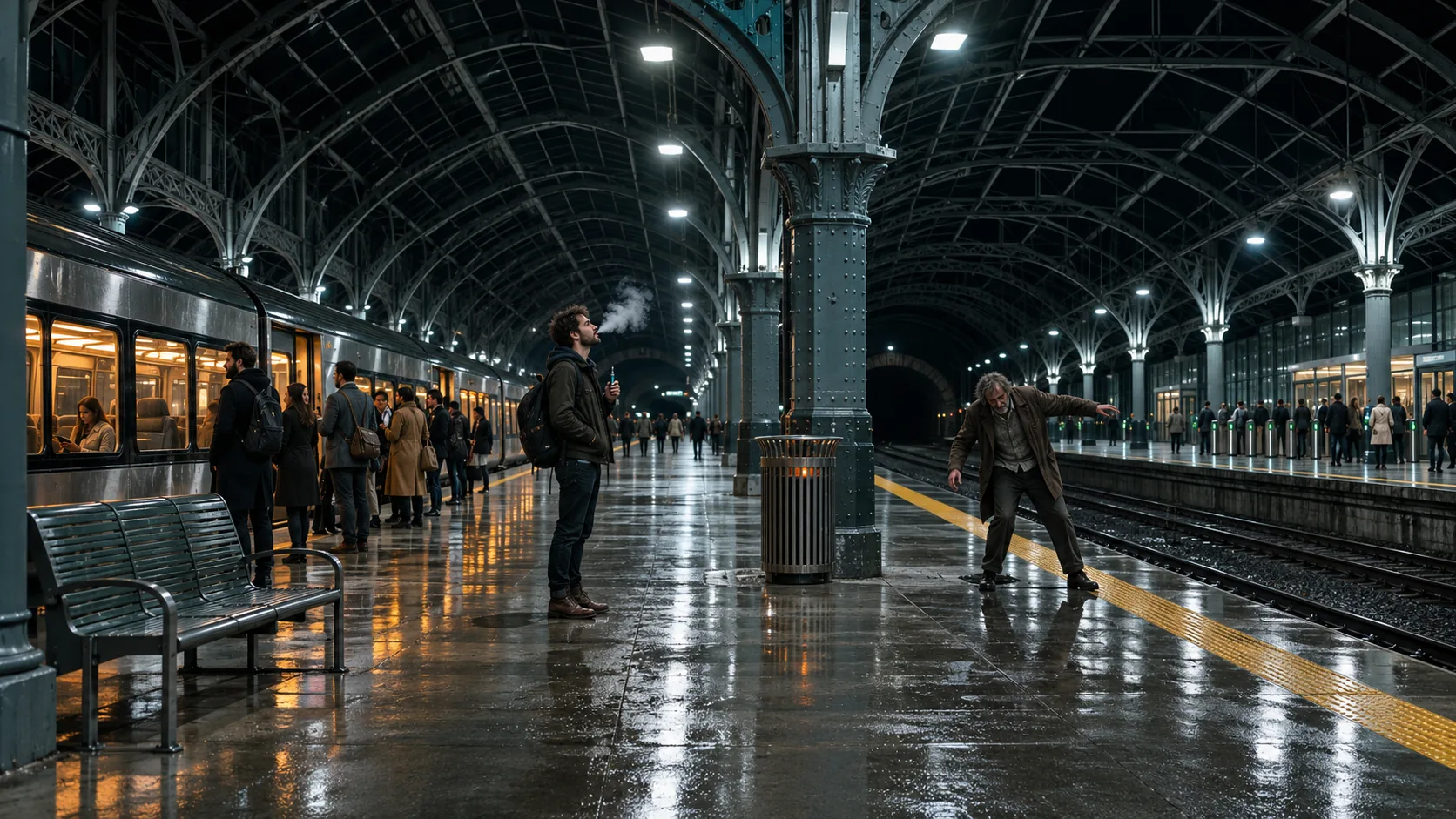
A crowded train platform at night, hazy and dark at first. As the image clears, the system flags a smoking waste bin, a person vaping in a no-smoking area, and an unsteady person near the platform edge.
Enactive AI
Our ISR and surveillance platform, MYSTIC, begins with vision. It understands its environment through sensor data and the physics of the real world, and it runs on the drones and cameras you already own.
75%
Clarity gain, validated in real-world degraded conditions
90%
Detection and tracking accuracy
<50ms
Real-time latency on edge hardware
$0
New hardware required
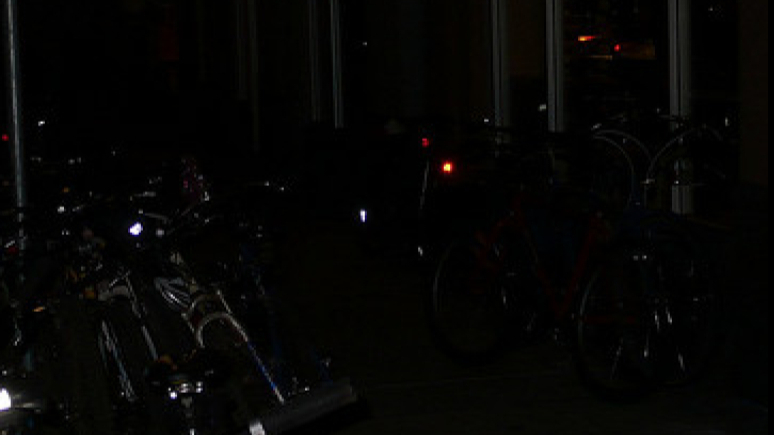
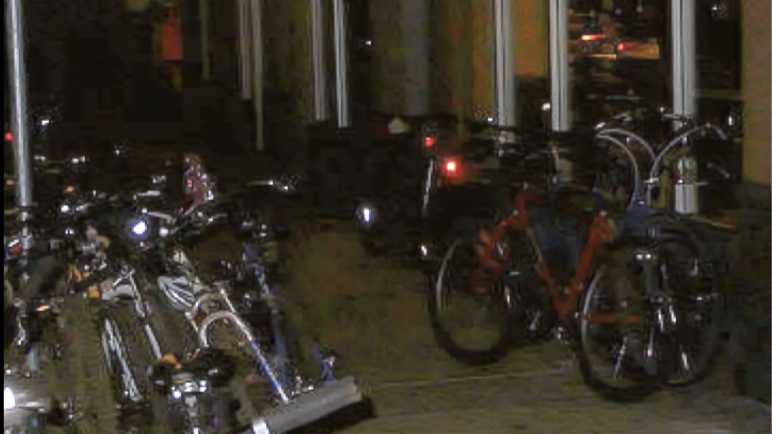
Real output
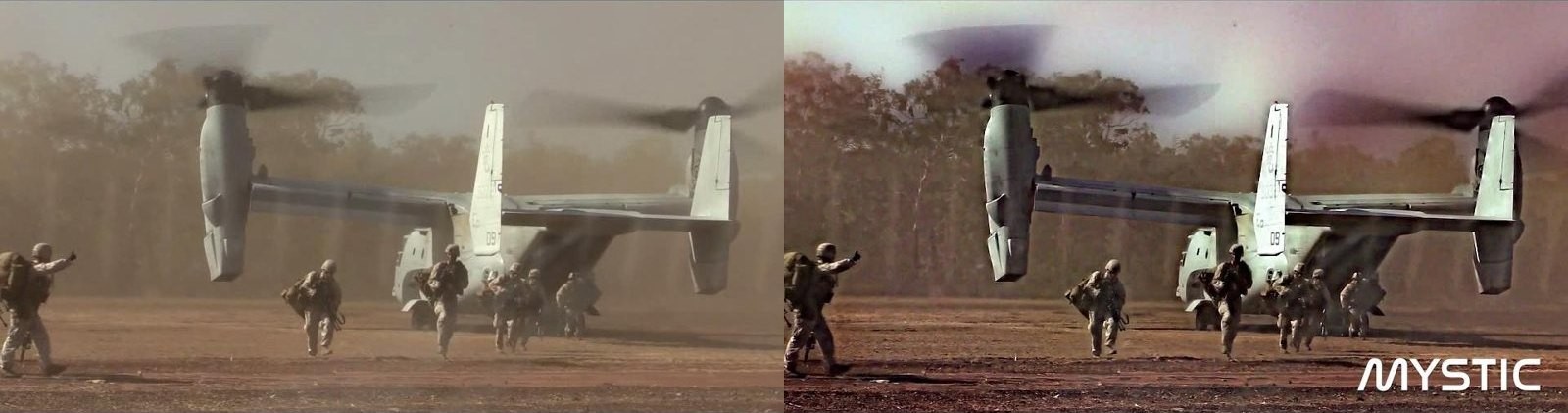 RawMYSTIC
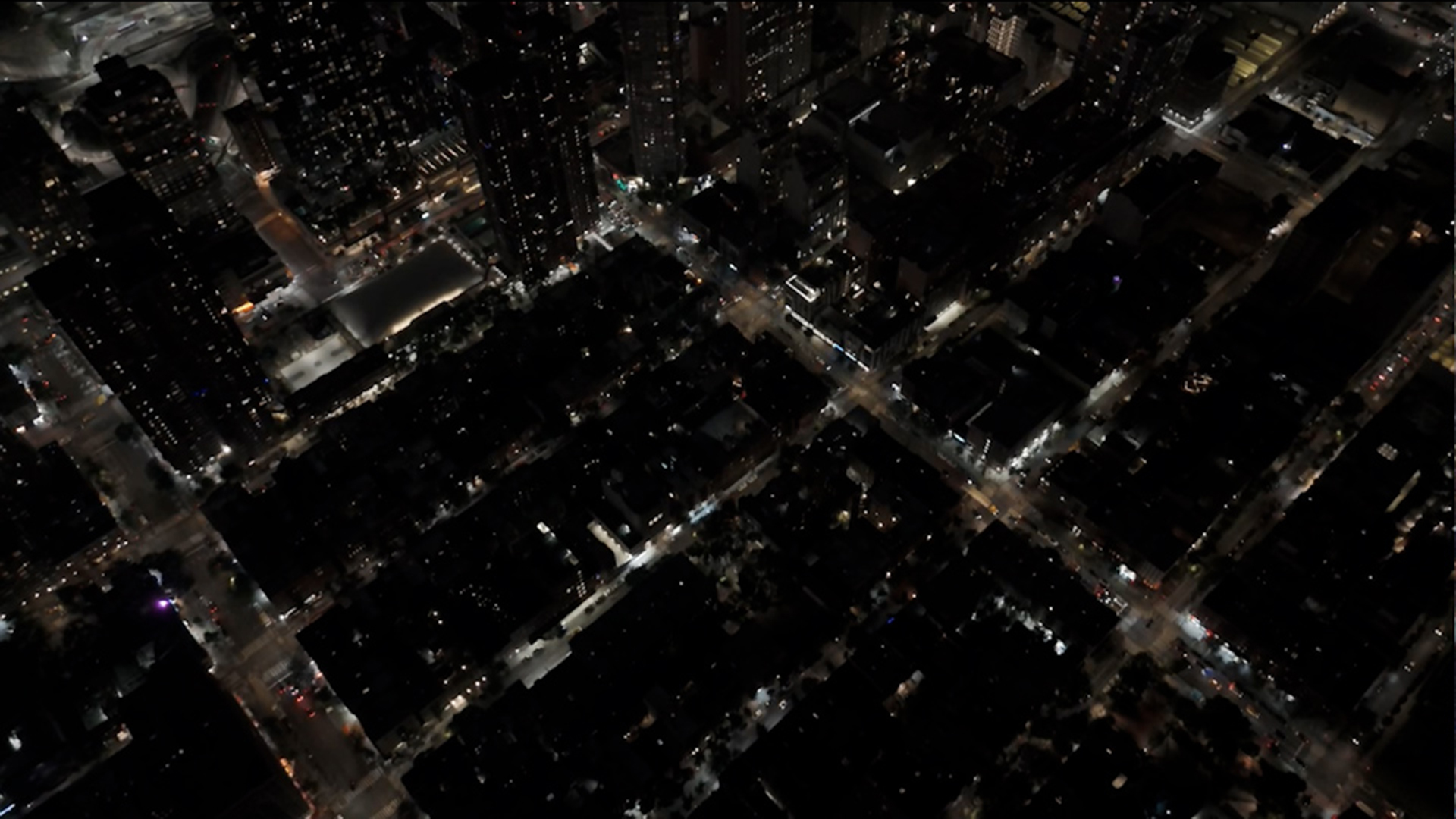
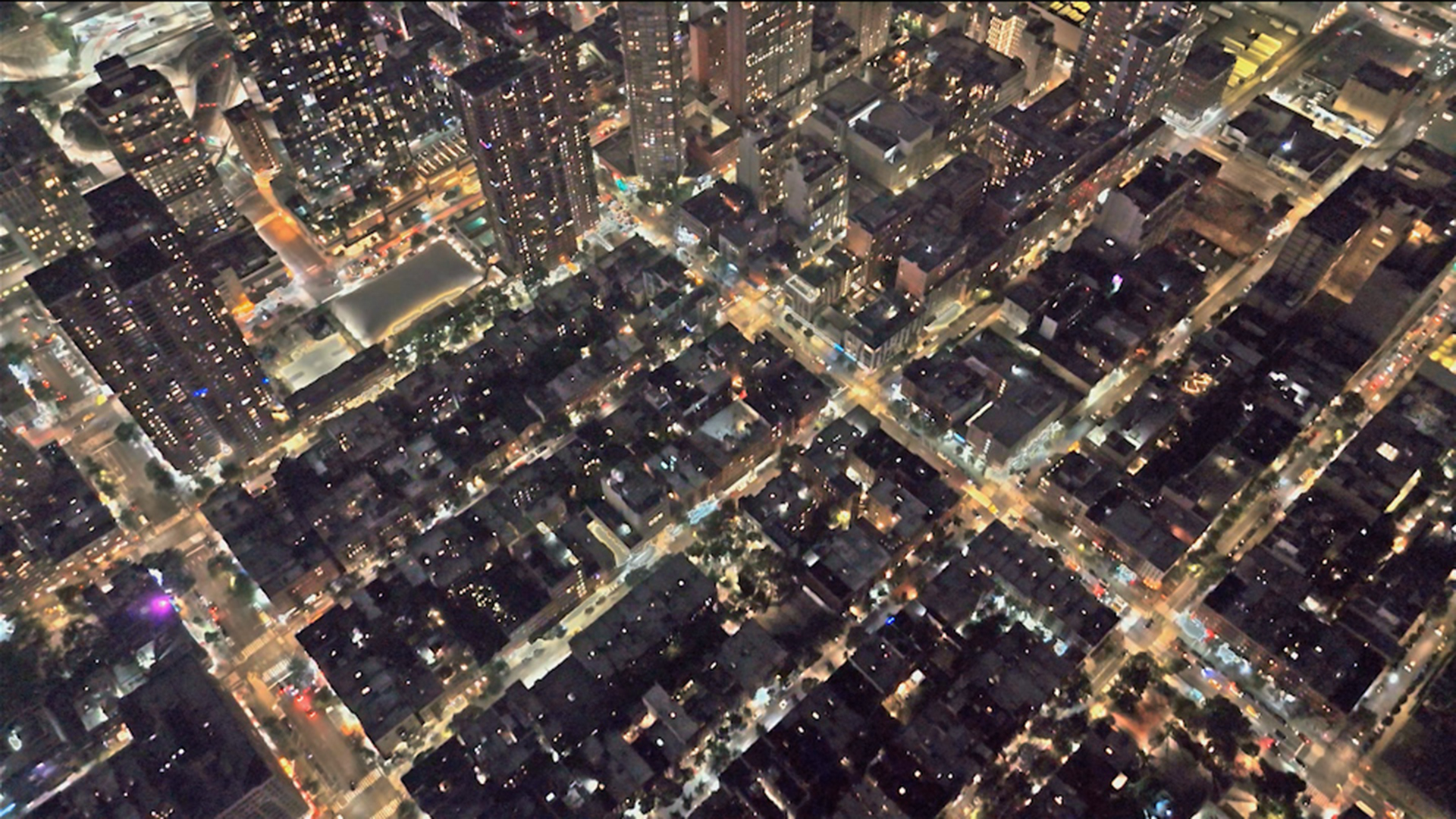
A crowded park at night, buried in fireworks haze and glare. MYSTIC clears the scene and flags what the crowd has not noticed yet: a fire starting behind a stall, a person crossing a safety fence, and a crush forming at the exit. Across the bay, a naval base under sea fog. MYSTIC holds the whole waterfront and flags a small boat running without a transponder, a drone crossing the pier, and a figure where no one should be.
We are building the perception layer for machines that have to act.
Our thesis
The frontier AI systems of today learned everything from language. This is where we see artificial intelligence fall apart into hallucinations and cognitive gaps.
A model trained on descriptions becomes fluent in how reality is talked about without ever making contact with reality itself. That gap is the central unsolved problem in artificial intelligence, and scaling in data and compute will not close it. Grounding in reality will.
Absentia Technologies builds Enactive Artificial Intelligence (eAI) that engages the world directly. Our AIALF (Artificial Intelligence Adaptive Learning Framework) architecture learns from sensor signals and the physics of the environment, the way natural intelligence handles vision and perception.
Why Absentia
Today, AI learns from datasets, which means it sees the world once, frozen at the moment of training. That is a reasonable way to write text and access knowledge, and a dangerous way to tell an operator what is standing in front of them.
Enactive AI learns by engaging with the world instead of remembering it, coupled to its environment and adapting in the moment. Our AIALF framework predicts and validates the physics of a scene to aid its understanding of the real-world environment, instead of generating pixels it never saw.
Everyone else is scaling toward an AI entity. We are scaling toward AI capability, grounded in reality.
The LLM wall
The industry's answer to every limit on machine cognition has been more data and more compute. That worked while the product was language, because language is where the training data lives. It stops working the moment the output has to be accountable to our physical reality.
A model trained on records of the world becomes fluent in how the world is described and never makes contact with how the world is.
The industry has bet the house on the leap into physical machines. Drones, robotics, autonomous vehicles and industrial sensing all need a machine that can act on what is actually in front of it.
The prevailing architecture was never built to stay coupled to reality, and no amount of data centers can compensate for that.
The unlock
Biological intelligence never had this problem, because it never worked from descriptions. Cognition in nature emerges from continuous engagement between an organism and its environment. Perception and action are bound together, and reality corrects every prediction and conclusion in real time. Francisco Varela, Evan Thompson and Eleanor Rosch called this enaction, the view that intelligence is not computation performed on representations but action grounded in the physical world.
Enactive AI describes a system that carries a model of reality, tests it against the overwhelming incoming sensory signal, and updates on the difference. It stays accurate through accountability to the real world, like the rest of us.
The architecture
AIALF, the Artificial Intelligence Adaptive Learning Framework, is the architecture behind MYSTIC. It coordinates a network of specialized models, each assigned one task, from clearing fog and smoke to restoring low light and tracking objects across frames.
Its enhancement models estimate the physical conditions of a scene, such as how much fog sits between the sensor and the subject or how little light reaches it, and deterministic physics equations then use those estimates to recover the signal the sensor actually captured. Because the final image is computed by physics rather than generated by a network, AIALF cannot add detail that was not in the world. We call this physics-enforced inference, and it is why every MYSTIC output traces back to real signal.
Perception, not capture
An apple falls, but how do you catch it if you can never perceive the present?
Neural signal takes time to arrive, so by the moment an image reaches you the world has already moved on. What you experience is a running forecast, weighted by everything you have ever watched move and corrected until your fingers close around the apple. Perception is not a passive snapshot. It is an active prediction, disciplined by reality.
Machine vision, like a camera, treats each frame as evidence rather than as a test of anything, so an error introduced at the sensor travels intact to the output and arrives with unearned confidence. Biology inverts this. Predictions descend, incoming signal tests them, and only the error travels back up.
Step one
We started with vision because it is the primary way in which intelligence senses and couples to reality.
MYSTIC reads the scene, works out what is degrading it, and reverses that specific degradation. It is not filling in what the fog might be hiding. It measures the fog, and known physics undoes it, which means detail that was not in the world cannot appear in the image. At every step AIALF is predicting and validating those predictions through inference. When the incoming signal cannot be reconciled with physics, the system flags it rather than smoothing it over.
A machine cannot decide what to do about something it cannot see. Improve the way it senses and the picture gets better. Give it the architecture of perception and it improves the operator's ability to see clearly and respond quickly.
One scene
Sight alone is not perception. An organism does not maintain a separate world for each sense. It maintains one world that every sense contributes to.
Fusion is next for MYSTIC. Electro-optical, infrared, radar, acoustic and inertial inputs resolved into a single continuous estimate of what is actually there, where a track acquired on one sensor stays the same track on the next, and a signal too weak to trust alone becomes decisive in combination.
The sensor
Today's sensors were designed for human eyes and human displays. They optimize for a picture, and they discard much of what they measure in order to produce one. A machine that perceives by prediction wants the opposite, every physical measurement it can get, at every moment, in real time.
MYSTIC is software that runs on the cameras, drones and sensors you already own, recovering more of the signal they capture without new hardware or a rip-and-replace upgrade.
Step two
An organism perceives in order to act, and acts in order to perceive better. Movement changes the view, the new view corrects the model, and the corrected model directs the next movement. That is when enaction becomes possible.
This is why perception had to come first. Autonomy has been bottlenecked on it the entire time. A machine cannot decide what to do about a thing it cannot resolve and understand, and reacting to language and still frames is a dead end for perception. The moments an operator most needs the machine to think for itself, in fog, at night, in dust or after losing GPS, are the moments it goes blind.
What comes next
MYSTIC begins as sight for cameras. It becomes the perception layer for anything that has to act in the physical world. Drones, ground robots, maritime platforms, fixed infrastructure and entire sensor networks can hold one shared understanding of a place, in real time, on site, under the operator's hand.
We are building the AI that makes contact. Every feed answers to one understanding of what is real, and the operator's reach extends across all of it at once.
The ISR and surveillance platform for environments where visibility fails.
From thesis to field
MYSTIC is the first product built on AIALF, an ISR and surveillance platform that recovers real signal from degraded video in real time while adapting to the environment it observes. It installs as software on the cameras, drones and sensors already in the field, runs entirely on the edge, and lets operators query feeds, subjects and site activity in plain language.
Every enhancement is governed by the physics of the degradation itself, so every output pixel traces back to signal the sensor actually captured. The result is evidence-grade clarity through fog, smoke, darkness and glare, without new hardware or a multi-year integration.
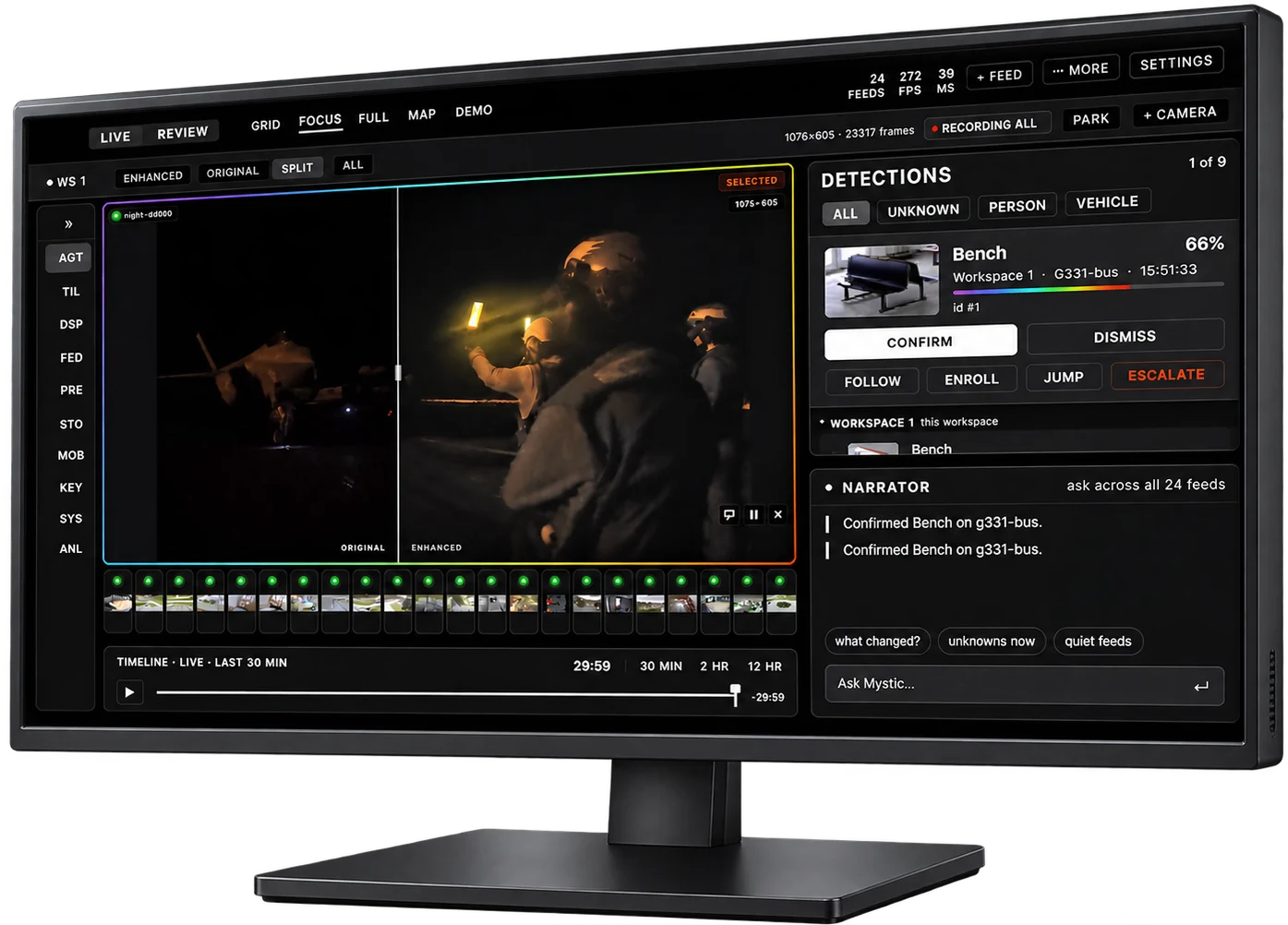
Clarity improvement and detection and tracking accuracy validated in real-world degraded conditions on existing hardware.
Fog, haze, smoke, rain and snow stripped from the feed in real time. Built for ports, borders, airports and commercial perimeters.

Clean detail recovered at near-zero light. Built for night operations and around-the-clock site security.

Precise object detection and tracking across frames, from drone and satellite imagery to harbor approaches.

Heat shimmer, vibration blur and chromatic refraction corrected for long-range, aerial and maritime feeds.

Headlight bloom, floodlight wash and urban glow removed, restoring clean visibility in high-exposure environments.
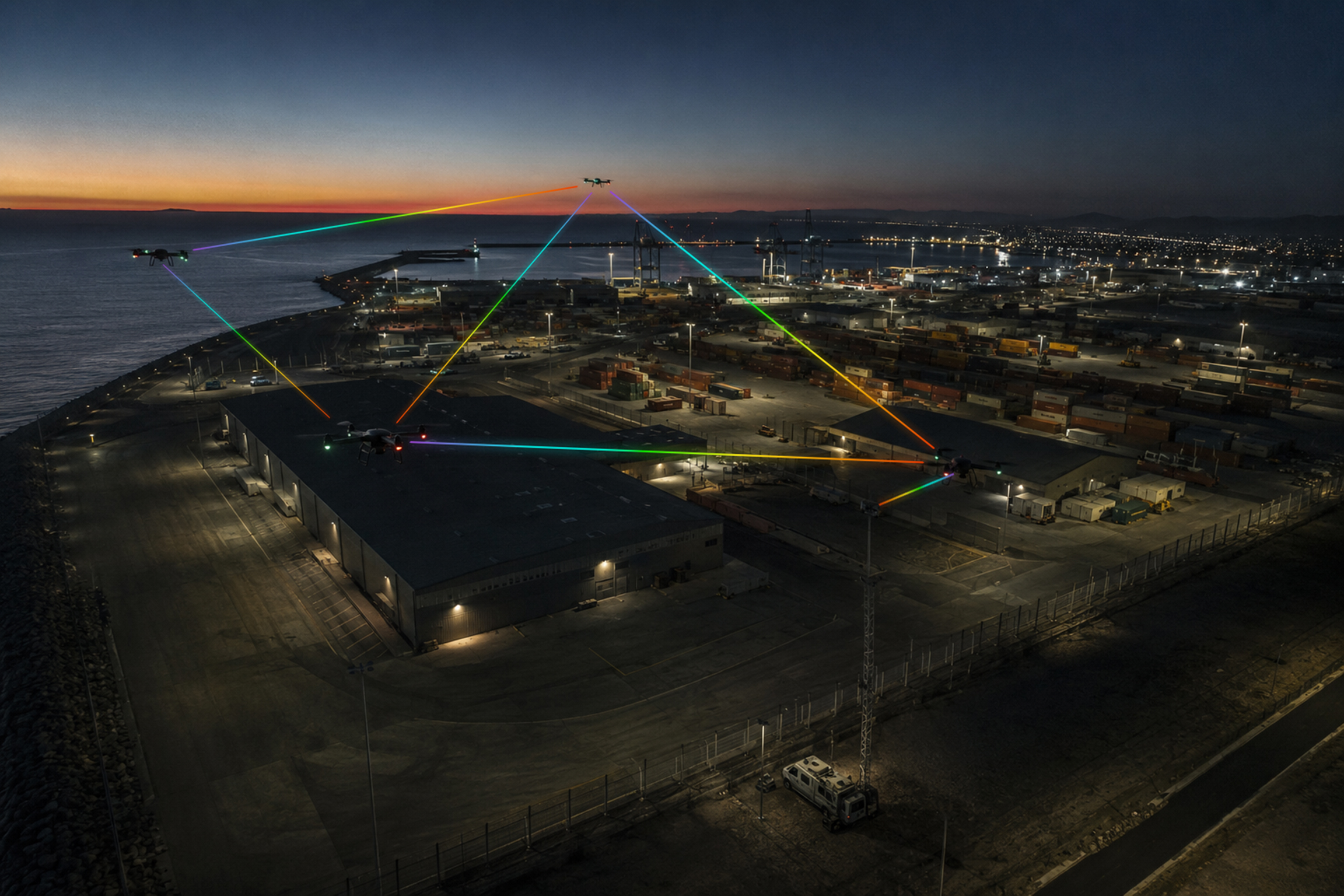

Query any feed, subject or site activity in natural language and get precise answers across every camera at once.
Real output
Simple and easy
A drone view over a battlefield at dusk, with military vehicles along a road, trenches and an artillery position. As the smoke clears, the system marks tree lines, hedgerows and open fields.
Absentia Technologies
Absentia Technologies was founded around a question the industry wasn't asking. Not how to make AI larger, but how to make it real.
Leadership

CEO / CTO

COO

Business Development

Senior Advisor
We are a small team with a contrarian thesis and field validation. If you think the dominant paradigm in AI is wrong and can prove it in code, in the field, or on paper, write to us at contact@absentiatech.com with the subject line Careers.

Machine Learning Engineer

Machine Learning Engineer

IT and Security
Machine Learning Engineer
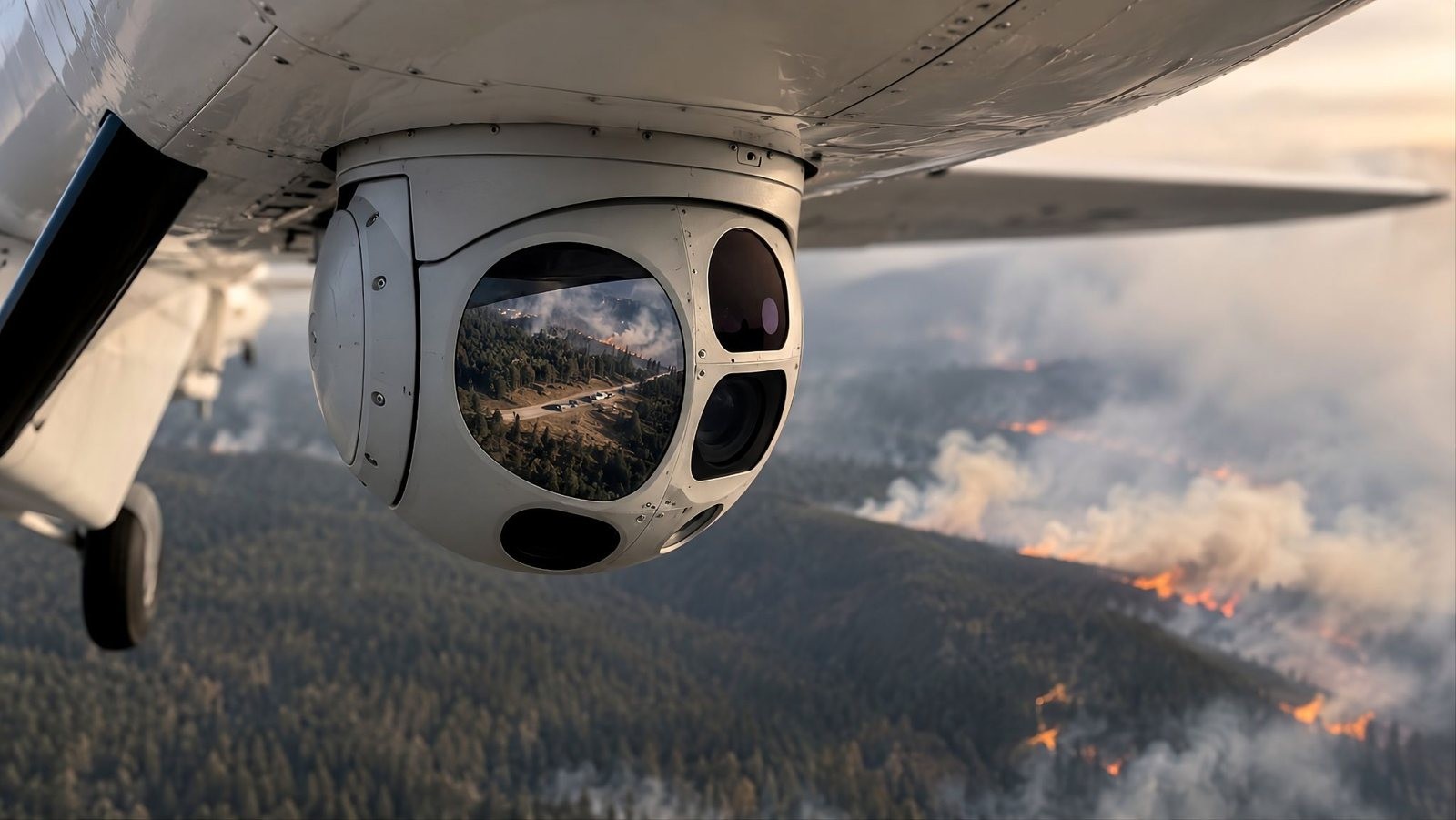
An aerial view over a forest canyon during a wildfire, hidden by smoke. As the smoke clears, the system marks the fire front and an exit road, then locks onto a person and their dog in a clearing and relays their location.
The blog
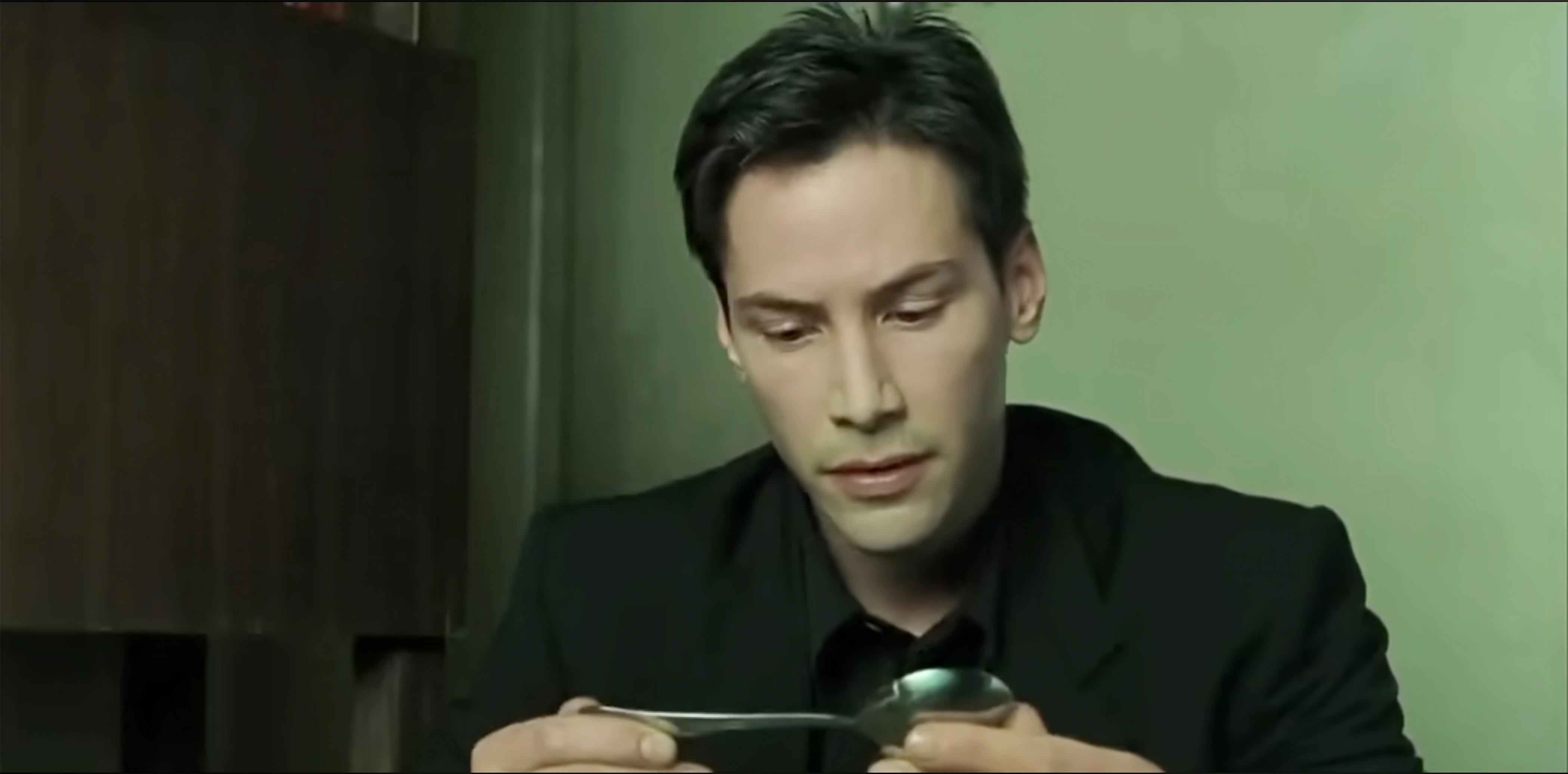
Aug 6, 2026 · 12 min read
There are three ingredients you cannot avoid when creating an intelligent organism: action, sensory feedback, and mortality.
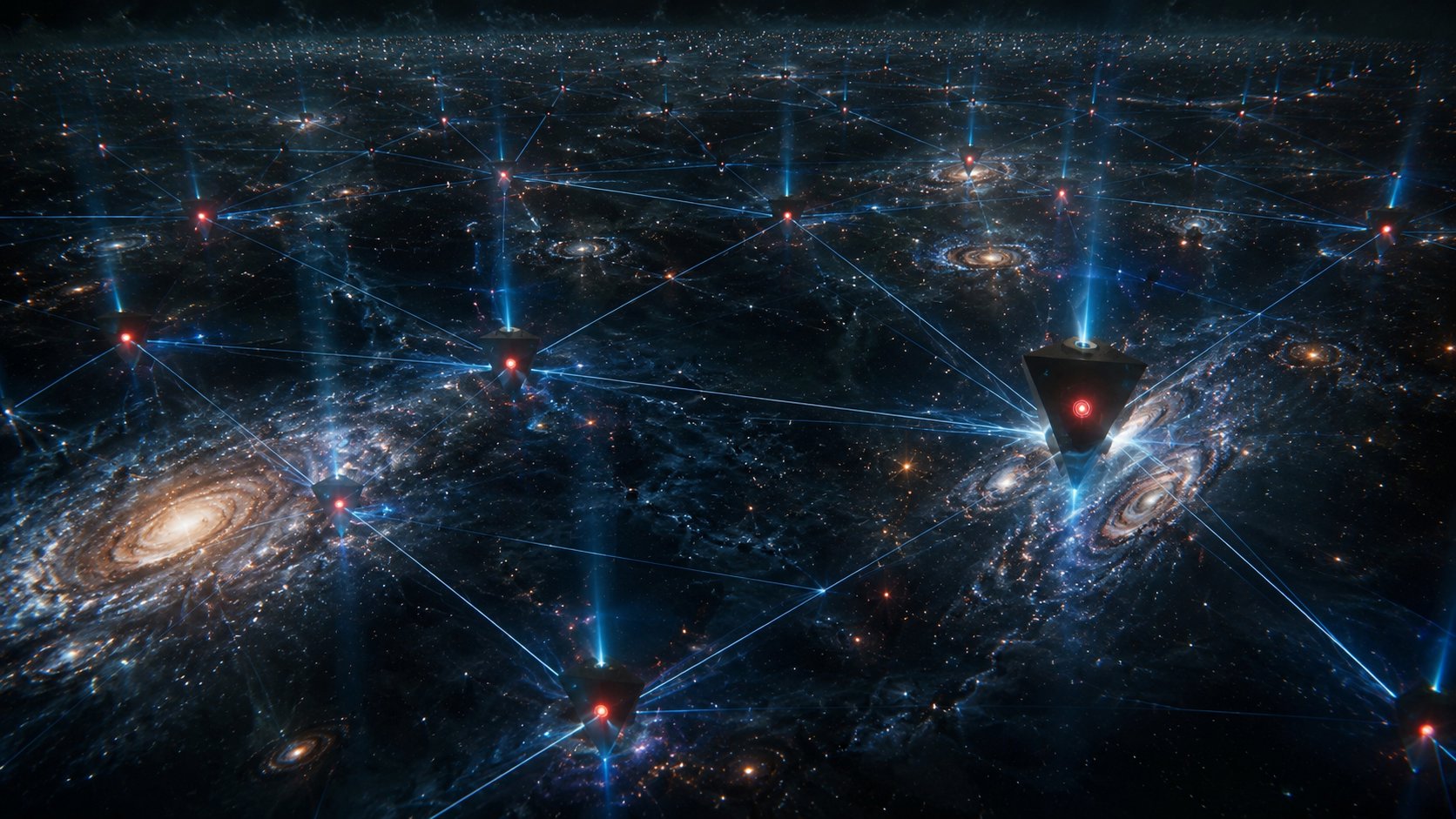
Jul 22, 2026 · 18 min read
This is why, at Absentia, we treat consciousness as a distraction rather than a destination. We do not need our systems to be conscious for them to perform cognitive work at or beyond the human level.

Jul 19, 2026 · 10 min read
They run on living tissue that is active every instant the animal is alive, continuously firing, continuously modulated by the world around it.

Jul 9, 2026 · 9 min read
When I was seven my mother took me to a bookstore so I could buy a book for the first time with my own money.
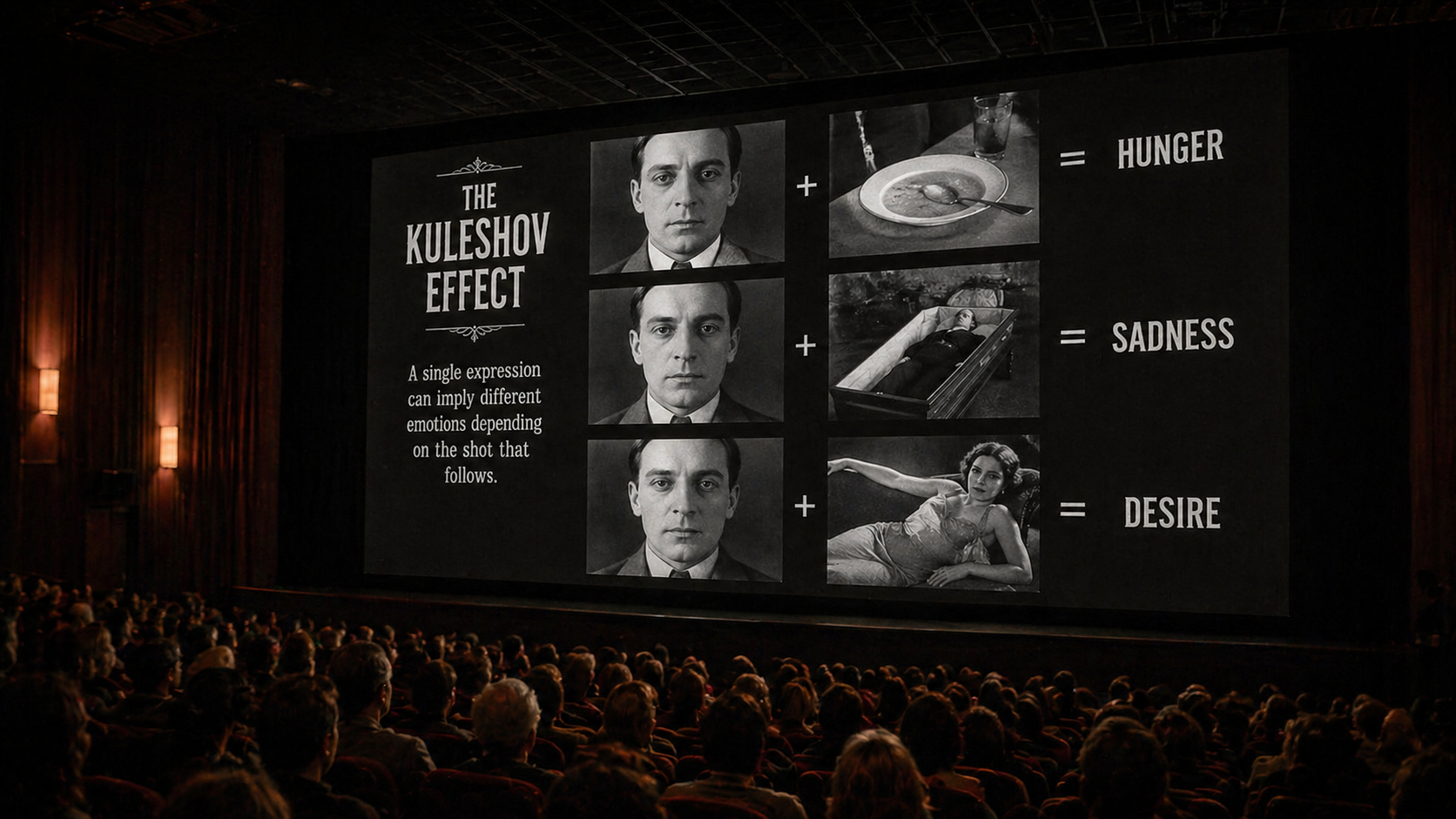
Apr 26, 2026 · 5 min read
There is a technique in filmmaking called the Kuleshov Effect, and it is one of the most uncomfortable discoveries in the history of visual storytelling.
Mar 18, 2026 · 8 min read
We are not interacting with a mind. We are co-authoring the illusion of one, filling in the gaps the way an audience fills in the frames.

Mar 5, 2026 · 10 min read
Language models trained on text are working at maximum distance from the world they are supposed to understand.
Mar 5, 2026 · 8 min read
The future of AI is not one enormous model that knows everything imperfectly. It is a network of specialists that know their domain precisely.
Nov 26, 2025 · 6 min read
The bubble is not in AI as a whole. It is in one specific bet: that endlessly scaling a single giant language model will somehow deliver artificial general intelligence.
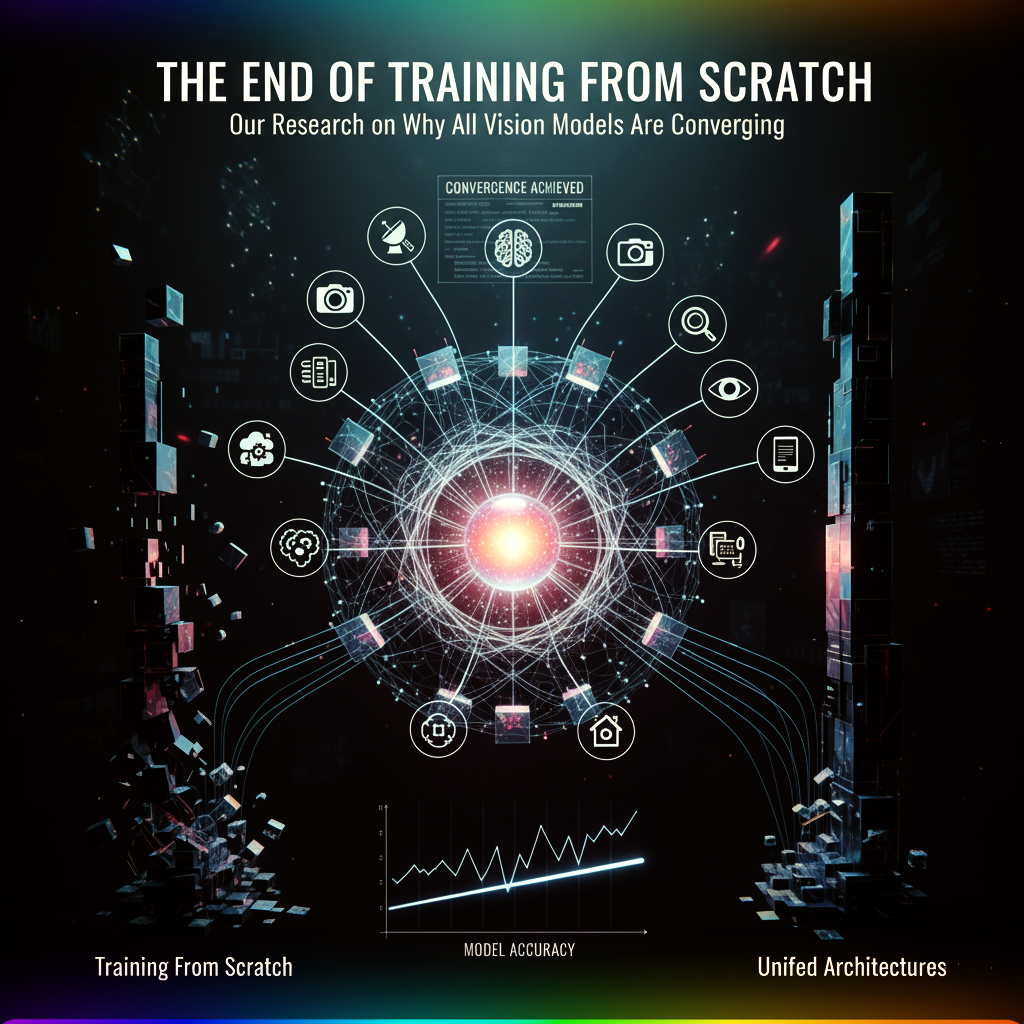
Nov 20, 2025 · 8 min read
One of our team members just had research accepted as a Spotlight at NeurIPS 2025, the top 1% of submissions to machine learning's most prestigious conference.
Nov 11, 2025 · 11 min read
How we developed a system that detects five primary degradation types and routes each frame through the appropriate restoration model in real time.
Oct 23, 2025 · 9 min read
We're not trying to replace human judgment. We're trying to give analysts enough information and insights so their judgment isn't blinded.
Press
The story we want told is about what happens when AI is built on physics instead of text. About an industry that mistook scale for intelligence, and what a genuine correction looks like. We want reporters covering the argument: where frontier AI structurally fails, why the architecture matters more than the benchmark, and what it means to build a system whose outputs are grounded in the real world. That is the conversation we are in, and we want to have it publicly.
We are building AI that sees the world as it is. We are looking for partners who want to build alongside us, whether that means co-developing on the AIALF architecture, integrating MYSTIC into defense or commercial platforms, or pushing the frontier of physics-grounded visual intelligence together. If your work touches ISR, sensor technology, computer vision, or surveillance infrastructure, and you want to do something that matters, reach out.
We are in limited rollout with defense and security partners. Request a demo for pilots and integration opportunities.